ACT - Digital platform for personalised wellbeing assessment
Building a dual-sided digital platform for personalised wellbeing assessment and professional care coordination.
Published 2026
Services
Product Architecture
Product Design & Prototyping
Front-end Development
Back-end Development
AI Integration
Timeline
3 months
About Age Care Technologies®
Age Care Technologies® (ACT®) provides digital tools that help older people express their health, independence, and wellbeing concerns, and connects them to the support they need to live a better life in old age.
ACT®'s platform spans four integrated tools:
ACT® Assess — a validated concern assessment across 56 dimensions of health and independence
ACT® Connect — real-time signposting to local services and support
ACT® Report — a personal summary that feeds into health and care records
ACT® Insight — population-level data and benchmarking for commissioners and policymakers
The platform is deployed across health and care systems in the UK and internationally, with an active research network spanning every WHO region.
The problem

ACT®'s assessment methodology is built on 35 years of research across 50 countries. But the tools delivering it hadn't kept pace with modern digital product standards, and the platform needed to serve two very different users at once.
Older people wanted to take a personal wellbeing assessment and get a support plan, without needing clinical help to do it. Care professionals, NHS organisations, and local authorities needed to manage assessments at scale, with governance, audit trails, and team structures built in.
ACT® asked Green Republic to build one platform for both, without compromising clinical validity for professionals, or simplicity for older people using it alone.
The platform had to:
Support two separate user journeys in one system: individual users and professional organisations
Guide individual users through a multi-step, human-feeling onboarding that still captures clinically relevant data
Deliver a structured, section-by-section assessment experience with contextual guidance and auto-save throughout
Generate personalised reports with concern prioritisation, NHS service matching, GP discussion prompts, and a user-driven focus step
Support a multi-tenant model where NHS trusts, care providers, and local authorities manage their own teams
Give organisations the tools to run targeted assessment campaigns, review AI-generated recommendations, and track population-level outcomes
Reflect NHS organisational identity: logos, organisation types, and a shareable Org ID for team onboarding
Stay genuinely accessible to older adults, including those with limited digital literacy
What made this project complex
The hard part was serving two opposite needs in one product. Older people need warmth and simplicity. Care professionals need control, governance, and population-level visibility. Meeting both meant getting the architecture right from day one.
The organisation model was the biggest technical lift: NHS branding, an Org ID system for onboarding colleagues, a manual approval workflow for clinical governance, and clear role separation between admins and assessors, all without making the interface feel heavy or technical.

Our approach
We structured the build around seven core challenges. Together, they form the architecture of the ACT® platform today.
1. A single platform, two distinct user worlds
The starting point was the fork screen, a single decision point that splits the product into two entirely separate journeys: individual users taking a personal assessment, and care professionals managing assessments on behalf of their organisations.
This wasn't just a UI decision. It determined the entire architecture: separate onboarding flows, separate account models, separate dashboards, and separate feature sets all within a single product with a shared design language.

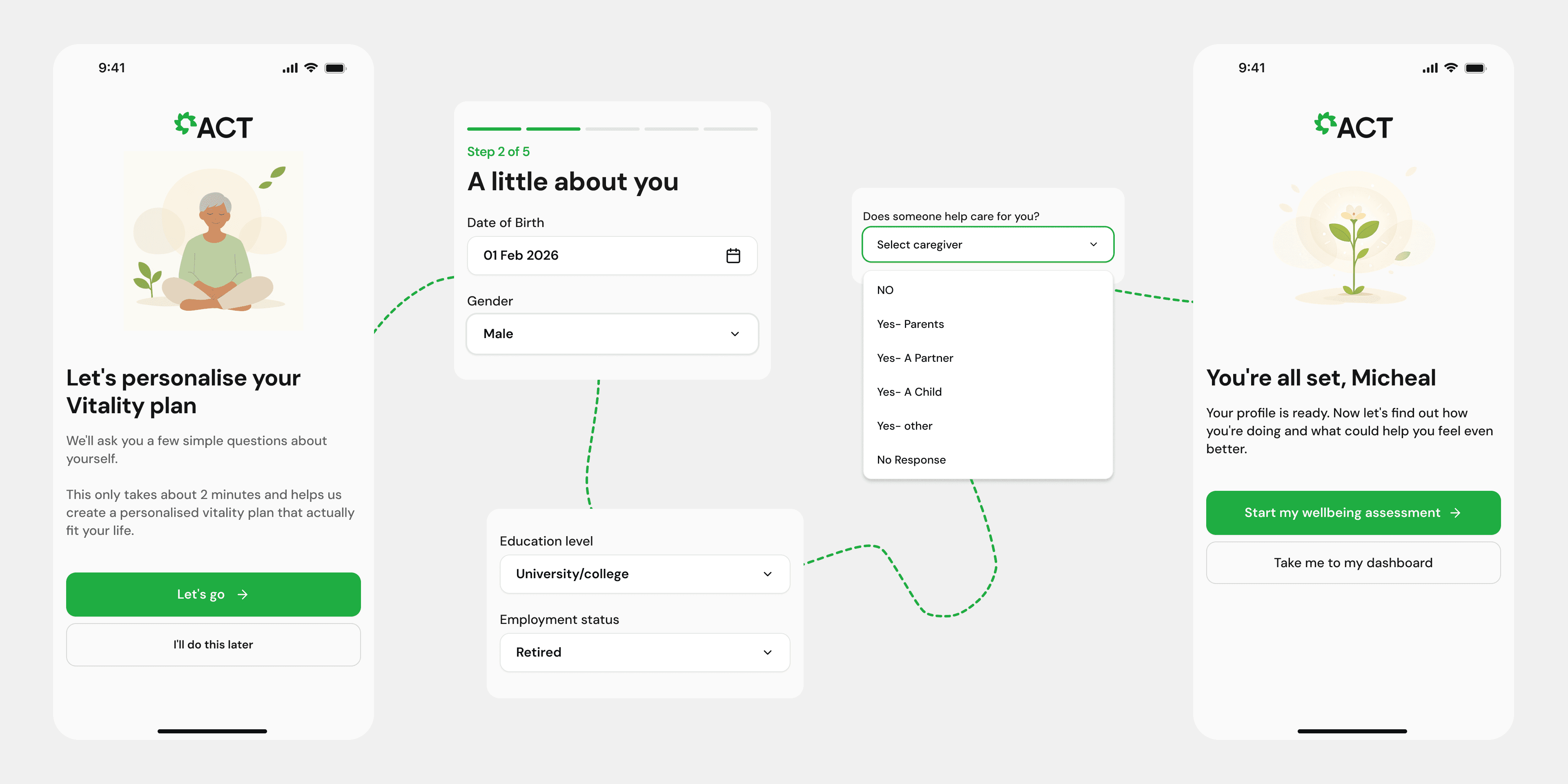
2. A guided, human onboarding flow for individual users
For older people, onboarding needed to feel like a conversation, not a form. We built a five-step flow that gathers the profile data needed to personalise their wellbeing plan:
Identity: name and optional NHS healthcare number
Personal details: date of birth, gender, marital status
Home life: living arrangement and caregiver support
Background: education and employment status
Contact: phone number and address
3. A structured assessment experience built for clarity
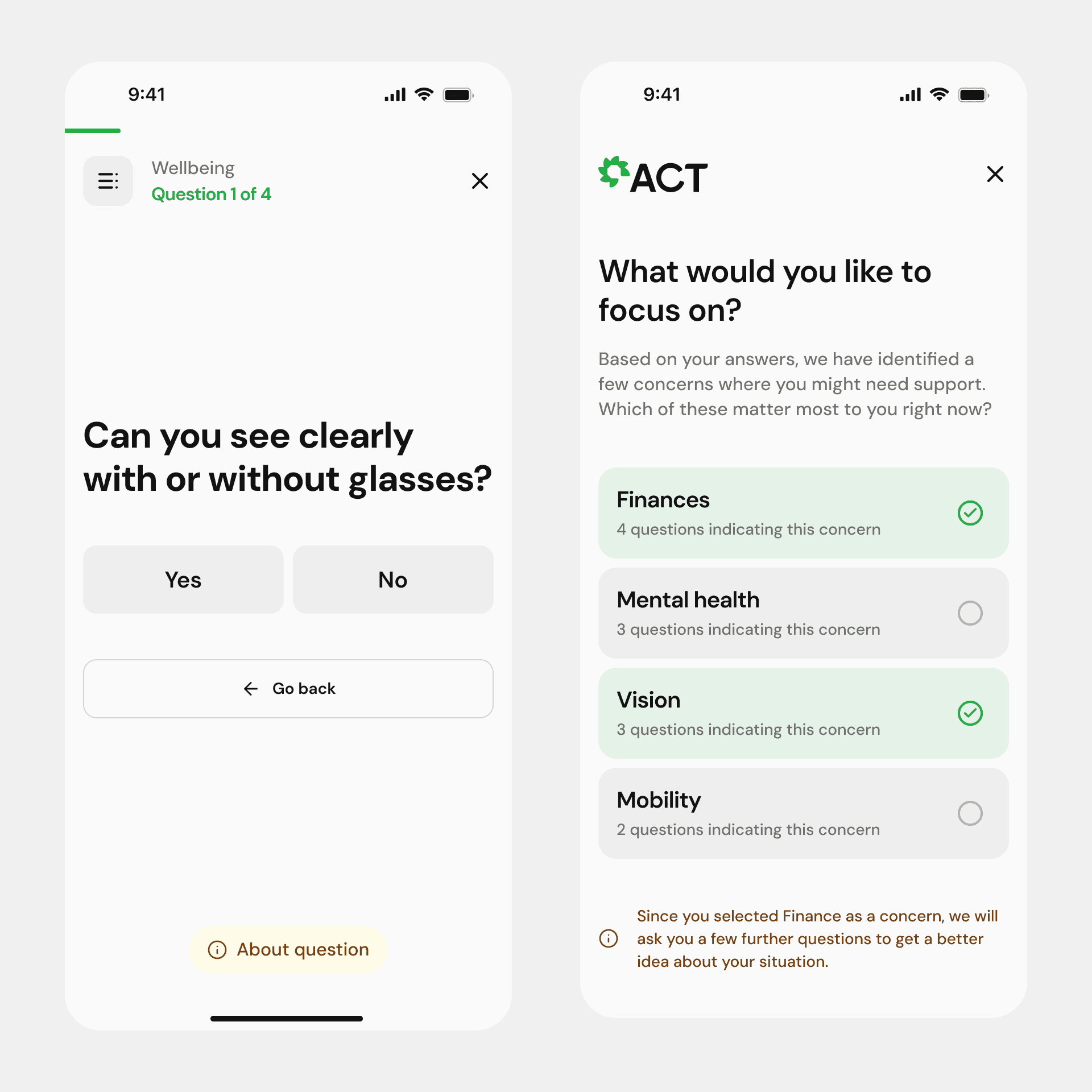
Before any assessment begins, users are prompted to set their accessibility preferences, text size and light or dark mode, so the experience is comfortable from the first question.
The assessment itself is structured into four clinical sections: Wellbeing, Independence, Staying Healthy, and Cognition. A progress sidebar shows all sections and the user's position within them at any point. Questions are binary and direct, but each one includes an 'About this question' tooltip that explains why it's being asked and what it helps identify, giving users confidence that the questions are purposeful, not intrusive.
Progress is auto-saved throughout. Users can pause and exit at any time and pick up exactly where they left off. At the end of the assessment, a loading screen signals that the personalised report is being generated, small details that make the experience feel considered rather than clinical.

4. Personalised reports that turn answers into action
Once the assessment is complete, users aren't immediately shown a fixed list of concerns. Instead, they're asked a question first: 'What would you like to focus on?' The platform surfaces the concerns identified across the assessment: Finances, Mental health, Vision, Mobility, and others and asks users to select which matter most to them right now. For any concern they prioritise, the system asks a small number of targeted follow-up questions to build a more precise picture before generating the report.
The report itself is structured in four sections:
Vitality snapshot — headline scores across Wellbeing, Independence, and Staying Healthy
Identified concerns — a prioritised breakdown by category, each with NHS facility recommendations and a tailored prevention plan
Things to discuss with your doctor — specific GP prompts generated from the user's answers, written in plain, non-alarming language
Next steps — including a 'Check up in 1 month' prompt that schedules a follow-up to track how the user's vitality is progressing over time
The completed report is saved permanently to the user's history, with a clear notice that it cannot be altered, preserving its integrity as a health record. It can be downloaded as a PDF, shared with a family member, carer, or GP, and users can leave optional feedback on the assessment experience.

5. Multi-tenant organisation infrastructure with NHS-grade governance
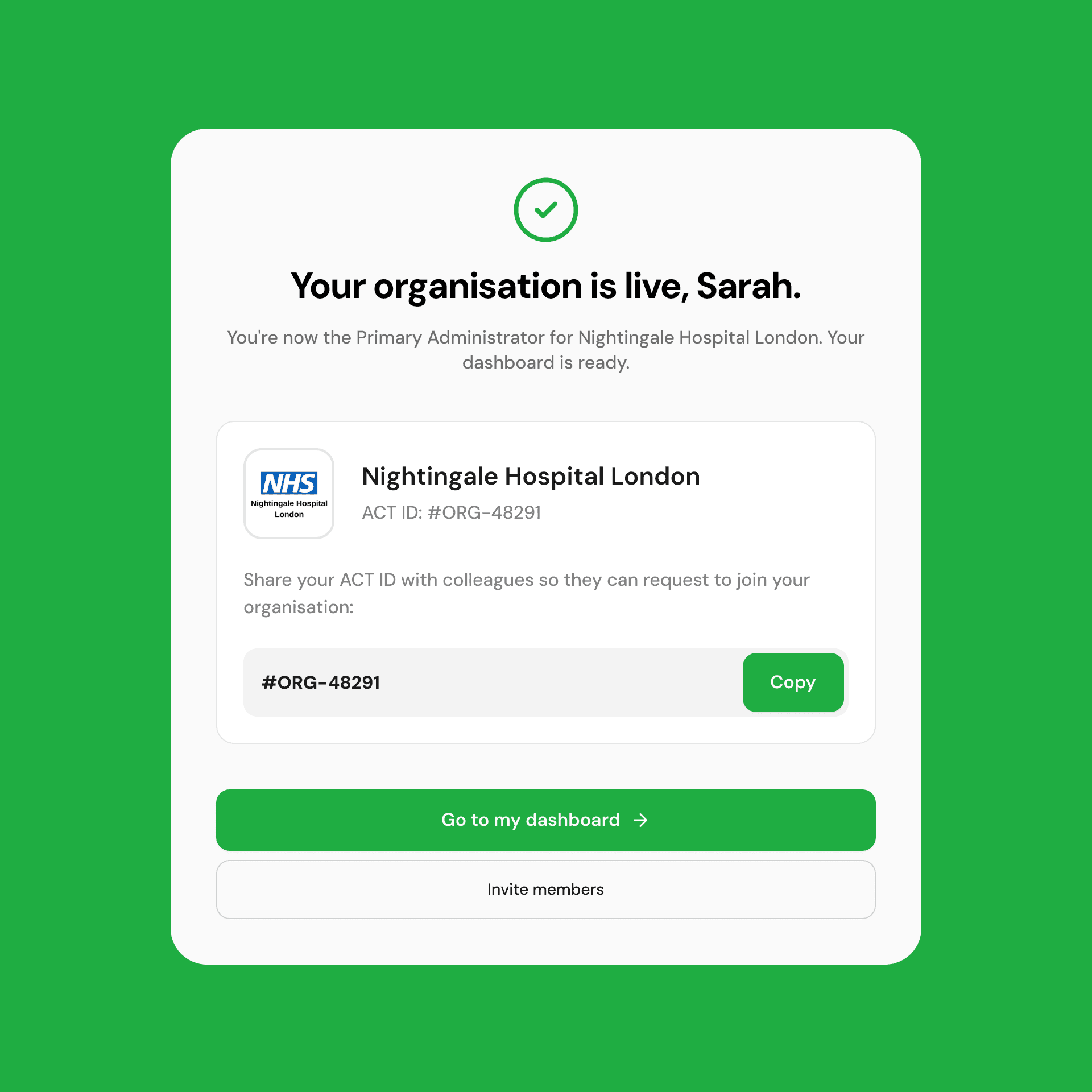
The organisation side of the platform was architecturally the most complex part of the build. Care providers, NHS trusts, and local authorities needed to be able to create their own organisation accounts, complete with branding (logo upload), categorisation (organisation type), and location (postcode), and then invite their teams to join.
We built a two-path organisation onboarding: either create a new organisation (setting up the admin account simultaneously) or join an existing one using a shareable Org ID. This Org ID mechanism, a unique identifier, allowed administrators to onboard colleagues without requiring a centralised invite system, making it practical for NHS teams operating across multiple sites and systems.

ACT®'s users span a wide range of contexts: an older person on a tablet at home, a care coordinator on a desktop in a clinic, an assessor on a phone during a home visit. Every screen in the platform was designed and reviewed in both mobile and desktop layouts from the beginning, not adapted after the fact.
This had a material impact on layout decisions throughout. Navigation patterns, form field sizing, button placement, and content hierarchy were reconsidered at each breakpoint rather than simply scaled. For older adult users in particular, accessibility was a non-negotiable constraint: type sizes, contrast ratios, and interaction patterns were all designed with lower digital literacy and reduced fine motor control in mind.
7. Authentication and secure account management
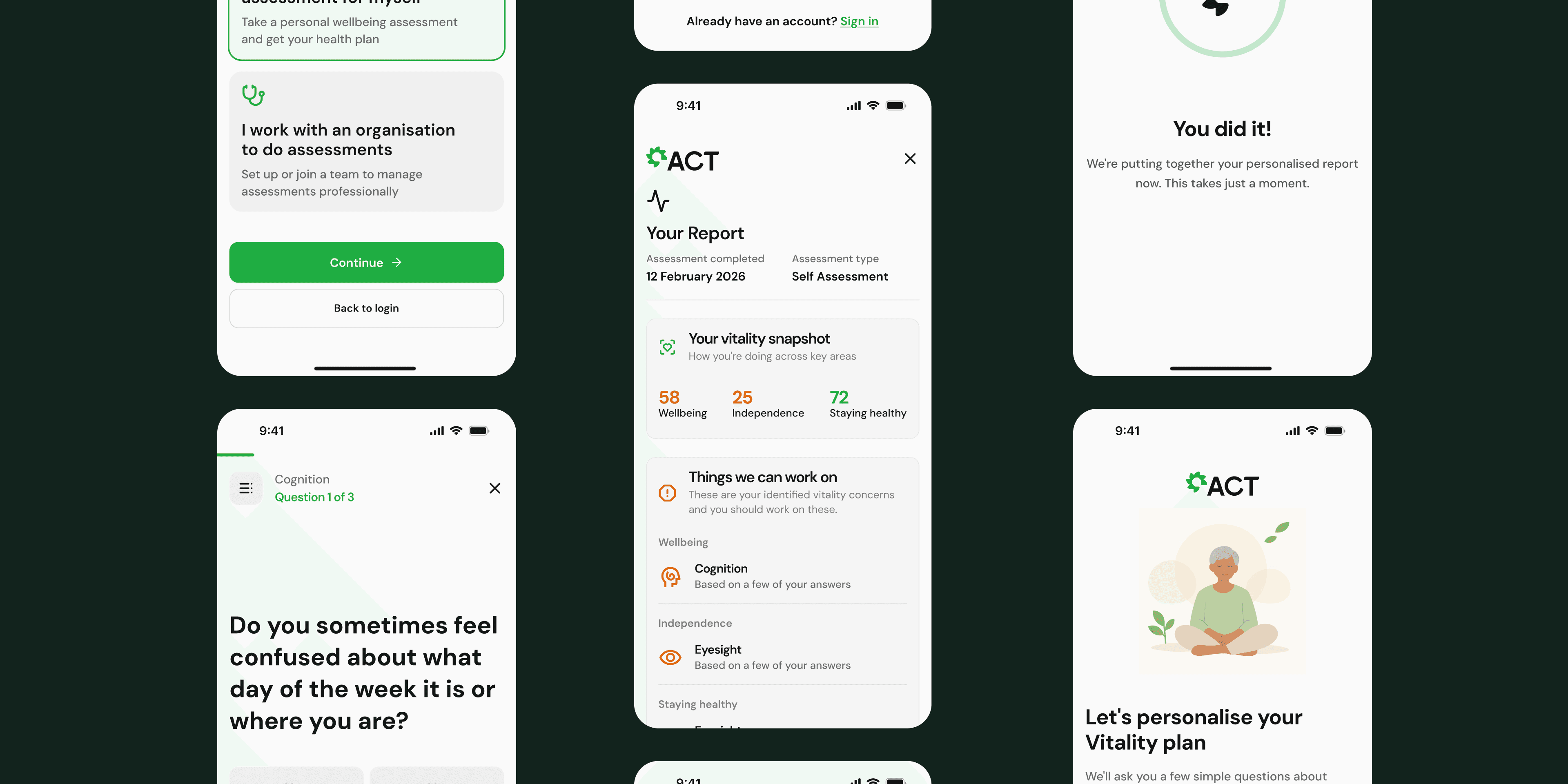
The platform's auth layer needed to support two distinct trust models: a lightweight, frictionless flow for individual older people getting started on their own, and a more controlled, governance-appropriate flow for professional accounts within NHS and care organisations.
For individual users, registration follows a standard email and password flow with clearly communicated password requirements, designed to be memorable and low-friction for users who may not frequently use digital products. Consent for anonymous data sharing to improve care services is collected explicitly at account creation, in keeping with ACT®'s data ethics principles.
For organisation users, additional safeguards are built into the flow: professional accounts require admin approval before activation, the platform clearly communicates this to new joiners, and the admin receives a notification to review and accept the request. This approval-gate model ensures that clinical audit trail requirements are met and that access to population-level assessment data is appropriately controlled.
Results and Impact
The ACT® platform is now live and serving both individual users and professional organisations across the UK and internationally. Since launch, it has delivered meaningful improvements across both sides of the platform:
Onboarding cut from 7 days to under 15 minutes
Assessments used to require a trained coordinator, with scheduling typically taking a week. Older people can now self-assess via a QR code or link and complete it in one sitting at home. Coordinators are freed up to focus on those who genuinely need assisted assessment. For NHS and local authority partners, the model no longer collapses under referral volume.
National coverage, any UK postcode
The earlier version was tied to specific pilot geographies. Coverage is now nationwide. Any older person anywhere in the UK can complete an assessment and get signposting relevant to where they live, including rural communities and deprived boroughs previously left out of digital prevention tools.
AI-curated signposting surfaces every relevant local service
Signposting used to rely on manually maintained directories that went stale quickly. The AI-curated layer now pulls from every identifiable source of support in an area, including NHS services, local authority provision, charities, and community organisations, matched to the person's prioritised concerns. The layer stays current without partner teams maintaining it.
These outcomes translate to real value across the ecosystem:
Older people can begin their wellbeing journey independently, without needing a professional referral or clinical support to get started
Care organisations can onboard and manage their entire assessment team from a single platform, with governance built in from the start
NHS trusts and care providers gain a consistent, auditable data layer that connects individual assessments to population-level insight via ACT® Insight
ACT®'s methodology can now scale globally, without proportional growth in operational overhead
This project took 35 years of world-leading research and gave it the digital infrastructure it deserved, a platform where any older person in the world can start understanding their own needs, and any care organisation can build the systems to respond to them.
Timeline
This project was delivered over the course of 3 months, spanning discovery and clinical methodology review, dual-track design prototyping (individual and organisation flows), front-end and back-end build, accessibility testing with older adult users, and phased deployment.
Tech Specs
The platform was built with accessibility, clinical data integrity, and multi-tenant scalability as core constraints from the outset.
Frontend
Backend & Authentication
Multi-Tenancy & Organisation Model
Infrastructure & Compliance
Dev Experience & Tooling